A New Era in Real Estate Transactions: The Mandatory Secure Payment System and the Deduction Shock for Sellers
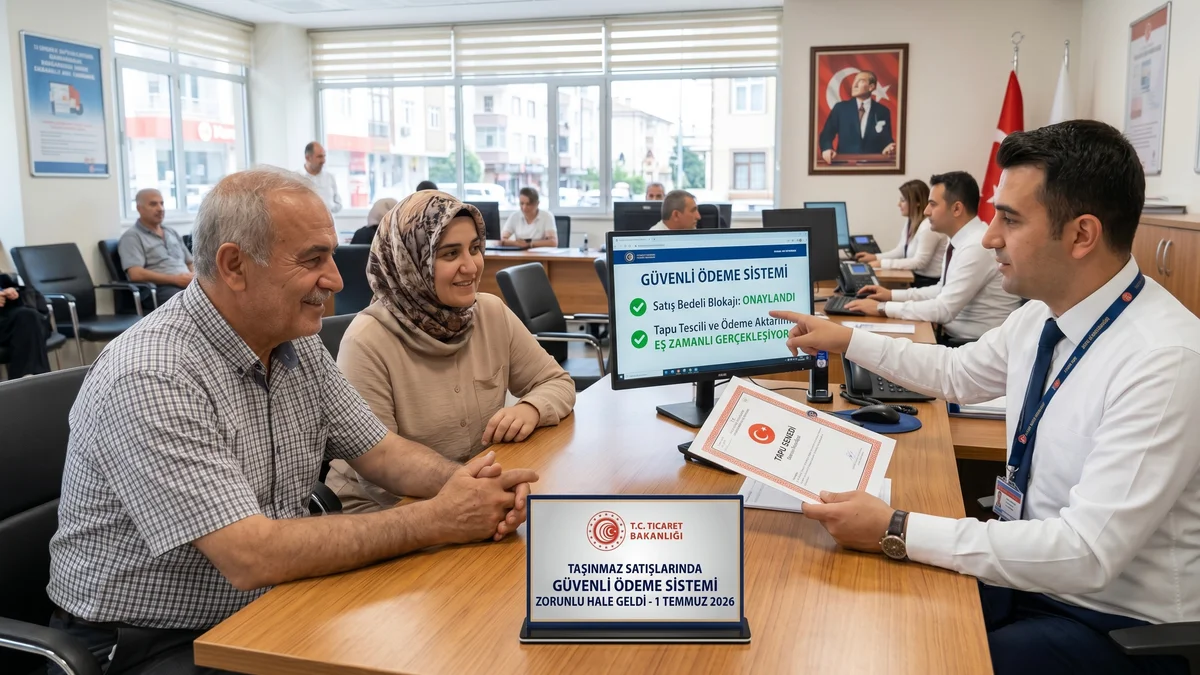
Secure Payment System in Real Estate Transactions: The New Era and Legal Analysis
Press Release from the Ministry of Trade and the Justification for the Regulation
In our country, the purchase price in real estate transactions is generally paid in cash directly between the parties. This practice gives rise to unrecorded transactions, payment disputes between buyers and sellers, creates a lack of commercial trust, forces parties to carry large amounts of cash, and uncovers severe risks such as theft and robbery.
Within this framework, comprehensively amending the Regulation on Real Estate Trade, the Ministry of Trade aimed to prevent parties from being exposed to fraud and theft risks, minimize unrecorded economic activities, and ensure that fund transfers are executed within a secure environment.
To ensure that the system is implemented thoroughly and on schedule, the Ministry of Trade, in collaboration with the General Directorate of Land Registry and Cadastre (TKGM), has initiated extensive technical infrastructure operations.
What Does the Amendment to the Regulation Encompass?
(Official Gazette Dated April 29, 2026 – Issue: 33238)
With the new article titled “Payment System” annexed to the Regulation, the rules governing real estate acquisitions and sales have been completely rewritten. The prominent modifications are as follows:
Mandatory System Utilization: In real estate sales, if the payment is executed via cash, wire transfer, EFT, or other methods designated by the Ministry, the transaction price must be processed through the Secure Payment System (Güvenli Ödeme Sistemi), which guarantees the concurrent exchange of real estate ownership and the purchase price.
Non-Credit Payments: This payment system shall also be utilized for portions of the real estate purchase price that are not covered by bank loans.
Deduction of the Service Fee: A transaction usage fee will be charged for operations executed through the system, and this fee shall be automatically deducted from the real estate purchase price to be transferred to the seller.
Establishment of a Specialized Commission: A specialized commission, composed of representatives from the Ministry of Trade and the Ministry of Environment, Urbanization, and Climate Change, will be established to handle technical tracking, identify systemic bottlenecks, and formulate solution proposals regarding the payment system.
Effective Date: According to the regulation, the utilization of the payment system will not be mandatory for real estate sales executed until July 1, 2026. The Ministry of Trade holds the statutory authority to extend this deadline for up to three months.
Objective and Anticipated Benefits of the New Regulation
The core objectives of the system, rendered mandatory to provide legal safeguards to buyers and sellers, prevent unrecorded transactions, and obstruct actions that disrupt social peace and commercial security—such as theft and fraud—are detailed below:
A) The End of Hand-to-Hand Cash Payments: From the effective date of the regulation, payments can no longer be executed in physical cash directly between parties. The objective is to resolve the trust issues between transacting parties and safeguard their mutual rights.
B) Implementation Schedule: The new regulation will enter into force on July 1, 2026, making it mandatory for real estate purchase prices to be processed exclusively through the “Secure Payment System.”
C) Safeguard of Simultaneous Performance: The transfer of funds and the transfer of ownership will occur concurrently (simultaneous performance / eş zamanlı ifa). This mechanism will eliminate malicious deceit and fraud, securely guaranteeing the seller's receivable and the buyer's acquisition of the title owner status.
D) Extension Authority: The Ministry of Trade holds the authority to extend the implementation timeline by three months to rectify potential systemic disruptions or deficiencies.
E) Inter-Institutional Integration: To ensure the seamless operation of the system, the Ministry of Trade and the General Directorate of Land Registry and Cadastre are executing joint technical infrastructure integrations.
F) Social Peace and Commercial Trust: The new system will establish commercial trust by preventing legal disputes within the real estate sector.
Our Legal Assessment: Unjust Burden Imposed Upon the Seller and the Risk of an Annulment Lawsuit
While this system aimed at securing transactions is highly beneficial, a specific provision regarding its execution triggers severe legal controversies.
The provision in the Regulation stating, “A usage fee will be charged for operations executed through the system, and this fee shall be deducted from the real estate purchase price to be transferred to the seller,” explicitly violates the fundamental principle of the “Equalization of Sacrifices” (Fedakârlığın Denkleştirilmesi İlkesi) in private law.
Deducting the entirety of the transaction usage fee solely from the purchase price (meaning exclusively from the seller) creates an unjust burden to the detriment of the seller and an unfair advantage in favor of the buyer. To align this mechanism with the Principle of the Equalization of Sacrifices, the transaction fee must be shared equally, collecting a half-rate ($50\%$) from the buyer and a half-rate ($50\%$) from the seller.
The Rule of the Mecelle and Equality in Public Burdens
This lopsided transaction cost also violates the principle of equality regarding public burdens. Codified in Article 87 of the Mecelle (The Ottoman Civil Code), the maxim “Mazarrat Menfaat Mukabelesindedir” dictates that detriment is the counterpart of benefit; meaning that whosoever enjoys the benefit of a transaction must equally bear the risks, liabilities, or expenses arising therefrom.
This ancient maxim of the Mecelle, mirrored in modern law as the “Benefit-Burden Balance” (Fayda-Külfet Dengesi), dictates that since both parties derive equal transactional security and benefit from the system, they must bear the operational costs on an equal footing. Therefore, splitting the transaction processing fee fifty-fifty between the buyer and the seller is a legal necessity.
Strategic Legal Warning: We must emphasize that this unilateral collection mechanism contained in the Regulation harbors a strong probability of becoming the subject of an Annulment Lawsuit (İptal Davası) before the Council of State (Danıştay) or the competent administrative judiciary organs in the upcoming period.
This article was prepared by Av. Mustafa MALGIR.