Eviction Guide 2026: Contract Terms, Rights of the New Owner, and Eviction Strategies
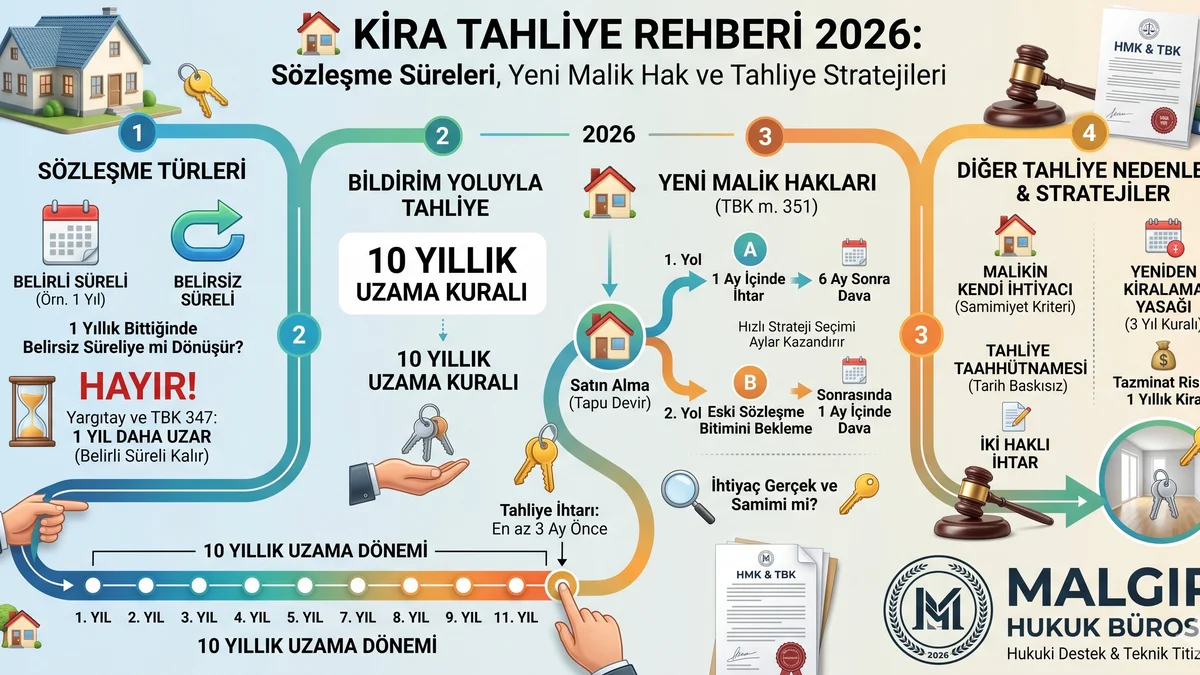
Comprehensive Guide to Tenant Eviction: Your Statutory Rights under the Obligations Code and Civil Procedure Legislation
The termination of a lease agreement and the eviction of a tenant are not bound solely by the mutual volition of the parties; rather, they are strictly restricted to a limited number of statutory grounds (numerus clausus) and rigorous procedural rules prescribed under the Turkish Obligations Code (TBK) No. 6098. An incorrectly calculated notice period or a flawed choice of legal action can cause a property owner to suffer severe grievances lasting for years.
As Malgır Law Firm, we clarify the most frequently confounded technical details and strategic actions of tenancy law for you.
1. The Distinction Between Fixed-Term and Indefinite-Term Lease Agreements (The Most Common Misconception)
The primary step in calculating the correct timeframe for initiating an eviction lawsuit is identifying the exact legal category of your contract.
Fixed-Term Lease Agreement (Belirli Süreli Sözleşme): Contracts where the commencement and expiration dates are explicitly written and defined (e.g., a 1-year lease).
Indefinite-Term Lease Agreement (Belirsiz Süreli Sözleşme): Contracts where no expiration date is envisioned or where the duration remains open-ended.
Critical Legal Question: Does a 1-Year Contract Automatically Convert Into an Indefinite-Term Lease Upon Expiration?
Contrary to numerous inaccurate sources available on the internet, the jurisprudence of the Court of Cassation and Article 347 of the TBK are absolute: in residential and roofed workplace tenancies, when a 1-year (or any fixed-term) lease expires, if the tenant does not issue a notice of evacuation at least 15 days prior, the contract DOES NOT convert into an indefinite-term lease. Instead, it is deemed extended for another 1 full year under identical terms.
Consequently, the contract legally continues its lifespan as a “fixed-term” agreement that systematically renews itself annually. As a rule, it is legally impossible for a residential lease contract to automatically transform into an indefinite-term lease upon mere expiration.
2. Eviction via Notice: The 10-Year Statutory Extension Rule (Art. 347 TBK)
This constitutes the solitary legal path through which a property owner can evict a tenant without demonstrating any specific statutory justification (such as necessity, an undertaking, etc.).
Timeline Tracking: Suppose you have a 1-year fixed-term lease. At the conclusion of that 1st year, the contract enters a 10-year statutory extension phase (uzama evresi). Once these 10 extended years have completely expired (meaning virtually at the conclusion of the 11th year of the tenancy), you can legally demand eviction by serving a notarial notice to the tenant at least 3 months prior to the expiration of each subsequent extension year.
3. The Neccessity of the New Owner and Alternative Statutory Options (Art. 351 TBK)
When you purchase a residential property or a commercial shop that houses an active tenant, the TBK provides you with two distinct legal alternatives. Discerning the strategic difference between these two paths can save you months, or even years, of litigation:
Option 1: The 1-Month / 6-Month Rule (Special Statutory Period)
You must serve a notarial notice to the tenant within 1 month from the exact date of purchase (the title deed transfer date), notifying them that you have acquired the real property and require it for personal use. Following the service of the notice, you can initiate an eviction lawsuit 6 months later.
Strategic Deployment: This path is logically sound if there is a long duration remaining until the expiration of the pre-existing lease agreement (e.g., 9 to 10 months).
Option 2: Direct Litigation Based on the Pre-existing Contract (The Alternative Path)
Upon purchasing the property, you legally step into the shoes of the former lessor, directly becoming a party to the pre-existing lease contract. The new owner may choose to completely bypass the 1-month/6-month rule, await the natural expiration date of the current lease, and file an eviction lawsuit based on personal necessity directly within 1 month following the expiration date of the contract.
Strategic Deployment: For example, if you purchased the property on October 1st and the tenant's pre-existing contract expires on December 31st; instead of waiting for 6 months (until April) under Option 1, it is much faster and more practical to simply await December 31st and file the lawsuit directly within the month of January!
4. Personal Necessity of the Current Lessor / Property Owner (Art. 350 TBK)
The lessor can initiate an eviction lawsuit if they require the real property for themselves, their spouse, their descendants (altsoy - children/grandchildren), their ascendants (üstsoy - parents/grandparents), or other dependents whom they are legally obligated to look after.
The Criterion of Sincerity: Pursuant to settled Court of Cassation jurisprudence, the necessity must be “genuine, sincere, and mandatory.” If you initiate this lawsuit while owning another suitable property that stands vacant, your case will be summarily dismissed.
Time Limitation: The lawsuit must be filed within 1 month from the expiration date of the contract. (If a notarial notice of intent was served prior to expiration, this 1-month litigation window is deemed extended for another full tenancy year).
5. Eviction Undertakings and the Rule of Two Justified Notices
Written Eviction Undertaking (Tahliye Taahhütnamesi - Art. 352/1 TBK): A formal document through which the tenant pledges in writing to vacate the premises on a specific date. However, signatures executed on the exact same day as the lease agreement are legally presumed to have been obtained “under duress” and are deemed null and void. Enforcement proceedings or an eviction lawsuit must be initiated within 1 month from the specified evacuation date.
Two Justified Notices (İki Haklı İhtar): If the tenant fails to pay the rent due on two separate months within the same tenancy year, and two distinct justified notarial notices are served, the lessor can initiate an eviction lawsuit within 1 month following the conclusion of that tenancy year.
6. The 3-Year Prohibition on Re-Leasing to Third Parties
Once you obtain an eviction decree based on personal necessity and remove the tenant from the property, you cannot lease that real property to any individual other than the evicted tenant for a duration of 3 years, unless a justified statutory ground exists. If you violate this prohibition, you are legally obligated to compensate the former tenant with an indemnity amounting to no less than the total sum of 1 year's worth of rent calculated based on their last active rate.
Conclusion and Strategic Legal Assessment
Tenancy law operates with the meticulous calculation of a chess match; your very first move (the exact date and specific wording of the notice you serve) pre-determines the final outcome of the litigation. A single flawed or premature notice can result in the complete waste of an entire year.
With our legal team commanding deep technical precision, Malgır Law Firm represents our clients through the execution of mandatory mediation processes, the drafting and serving of notarial notices, and the rigorous litigation of eviction lawsuits before the Civil Courts of Peace (Sulh Hukuk Mahkemeleri).
This article was prepared by Av. Mehmet Serhat MALGIR.