Crypto Asset Fraud and Criminal Liability Under the Turkish Penal Code
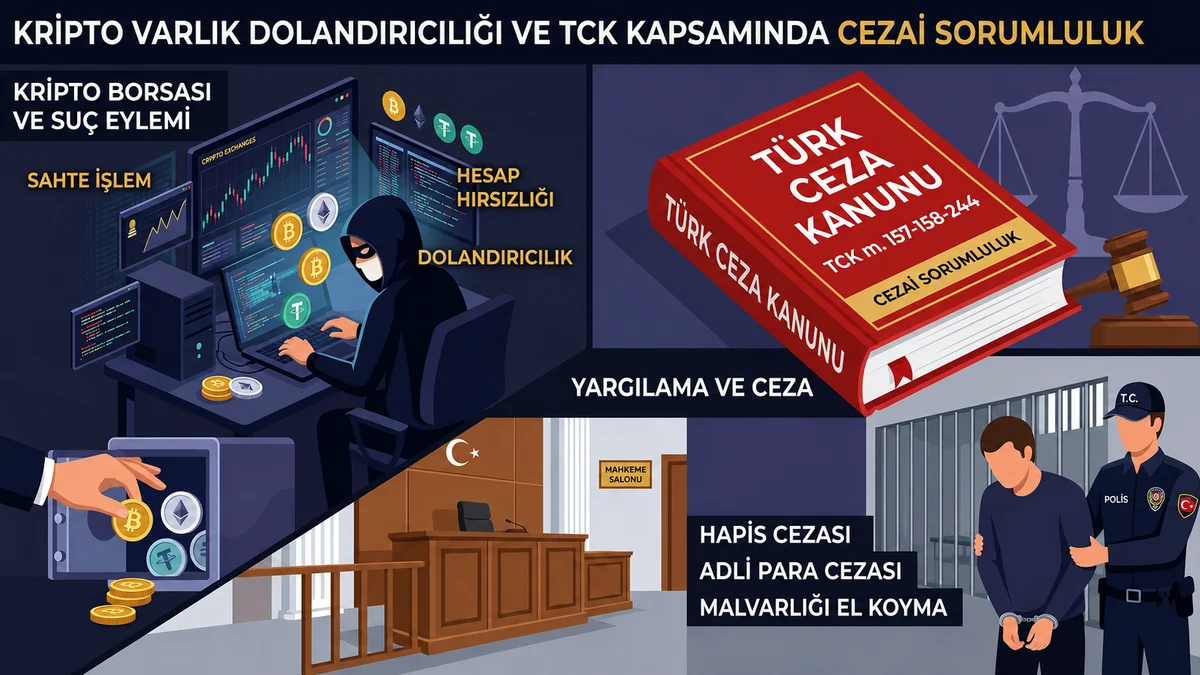
Crypto Asset (Cryptocurrency) Law and Aggravated Fraud
With the rapid evolution of blockchain technology and the deep integration of crypto assets (such as Bitcoin, Ethereum, etc.) into daily financial transactions, offenses against property have also systematically shifted to the digital landscape. Malpractices commonly designated as “cryptocurrency fraud” in practice are subject to significantly heavier criminal sanctions and distinct procedural investigation methods compared to traditional fraud offenses, due to their technical complexity.
As Malgır Law Firm, we deconstruct in full legal detail the cybercrimes committed through crypto assets, the specific legal remedies available to victims, emergency MASAK (Financial Crimes Investigation Board) measures, and the implementation of Article 158, paragraph 1, sub-clause (f) of the Turkish Penal Code (TCK) under the guidance of contemporary Court of Cassation jurisprudence.
Under Which Criminal Classification Does Cryptocurrency Fraud Fall?
Because crypto asset transactions are executed entirely online and through digital infrastructures, the Court of Cassation systematically classifies these acts under Article 158/1-f of the TCK, which regulates the offense of “Aggravated fraud committed through the utilization of information systems, banks, or credit institutions as an instrument.”
The statutory criminal sanctions attached to this offense are exceptionally severe:
Imprisonment: Pursuant to Article 158/1-f of the TCK, the statutory penalty for the base form of this offense ranges from 4 years to 10 years of imprisonment. The legislature has designated a specific mandatory lower limit for this paragraph, dictating that the imprisonment sentence cannot fall below 4 years. Consequently, as a rule of law, modern mechanisms such as the Suspension of the Announcement of the Judgment (HAGB) or the postponement/probation of the sentence cannot be implemented.
Judicial Monetary Fine: In addition to the imprisonment sentence, the perpetrator shall be sentenced to a judicial monetary fine that cannot be less than twice the unfair financial benefit obtained from the offense.
Consecutive Offenses (Zincirleme Suç): If the identical fraudulent scheme is executed against multiple victims within the framework of a single criminal resolution, the total penalty shall be increased from one-quarter ($25\%$) to three-quarters ($75\%$) pursuant to Article 43 of the TCK.
The Most Critical Distinction in Doctrine and Case Law: Aggravated Fraud vs. Aggravated Theft
The most complex legal characterization issue within crypto criminal law centers on how the perpetrator successfully seized the victim's digital assets. Under the Turkish Penal Code and settled high-court precedents, this technical distinction is of vital importance:
Aggravated Fraud (Art. 158/1-f TCK): If the perpetrator deceives the victim through fraudulent acts—such as launching fraudulent Initial Coin Offering (ICO) projects, setting up fake crypto exchange interfaces, or deploying malicious phishing methods—and causes the victim to voluntarily transfer their crypto assets into the perpetrator's digital wallet, the act constitutes the offense of aggravated fraud.
Aggravated Theft via Information Systems (Art. 142/2-e TCK): If the perpetrator, without engaging in any verbal persuasion or deception, directly exploits technical security vulnerabilities or cracks passwords (private keys) to breach the victim's digital wallet without their consent and routes the assets into their own account, the act constitutes the offense of aggravated theft via the utilization of information systems.
Legal Remedies and Urgent MASAK Freezing Orders Available to Victims
Because asset transfers within cryptocurrency fraud are executed in an encrypted format over the blockchain, tracking stolen or fraudulently seized funds is significantly more challenging than analyzing traditional wire transfers. Therefore, an emergency intervention strategy where seconds are counted is an absolute prerequisite.
MASAK Freezing Measure (Request for Asset Freeze): Pursuant to Article 19/A of the Law No. 5549, in cases involving an active suspicion of money laundering, terrorist financing, or severe aggravated fraud executed through cryptocurrency exchanges, the assets can instantly be frozen by MASAK for a duration of 7 business days.
Seizure Under Article 128/A of the CMK: Following the 7-day temporary administrative measure enacted by MASAK, the proceeds of crime can be permanently seized (subject to a judicial asset block) via the request of the Public Prosecutor and the subsequent formal order of the Criminal Judgement of Peace. These judicial seizure measures can fully be executed even over offline cold storage wallets (such as Ledger, Trezor, etc.), provided that the private keys or recovery seeds are legally discovered or secured.
Landmark Approach of the Court of Cassation
The 15th Criminal Chamber of the Court of Cassation and other matching penal chambers heavily emphasize the absolute necessity of comprehensive digital forensics and technical examinations in offenses executed across digital media.
For instance, in its landmark precedents, such as the decree dated Merits No: 2012/14684, Decision No: 2014/835, the 15th Criminal Chamber ruled that collecting funds from victims over social media networks or the internet via fake profiles, deceptive emails, and false promises of exorbitant investment returns must explicitly be penalized under Article 158/1-f of the TCK.
These landmark high-court decrees mandate that the direct causal link (illiyet bağı) between the “fraudulent behavior” (the substantive element of the crime) and the “vitiation of the victim’s free will” must be conclusively documented and proven through digital wallet transaction log files, IP address trackings, and certified digital forensics reports.
Conclusion
Crypto asset fraud litigation is a highly technical domain of specialization that cannot be navigated through traditional criminal law knowledge alone; it demands absolute mastery over blockchain ledger analysis, cold/hot wallet tracking, international mutual legal assistance channels (Interpol/Europol), and MASAK regulatory compliance frameworks.
Deploying our deep litigation experience in crypto fraud, unauthorized exchange access, and unlawful account blocks, Malgır Law Firm provides comprehensive criminal advocacy and specialized digital forensics consultancy across Turkey from our primary operational centers located in Ankara, Mersin, and Gaziantep, ensuring the robust protection of our clients' statutory rights.
This article was prepared by Av. Mehmet Serhat MALGIR.