Legal Principles of Matrimonial Property Division: The Liquidation Process and Statute of Limitations
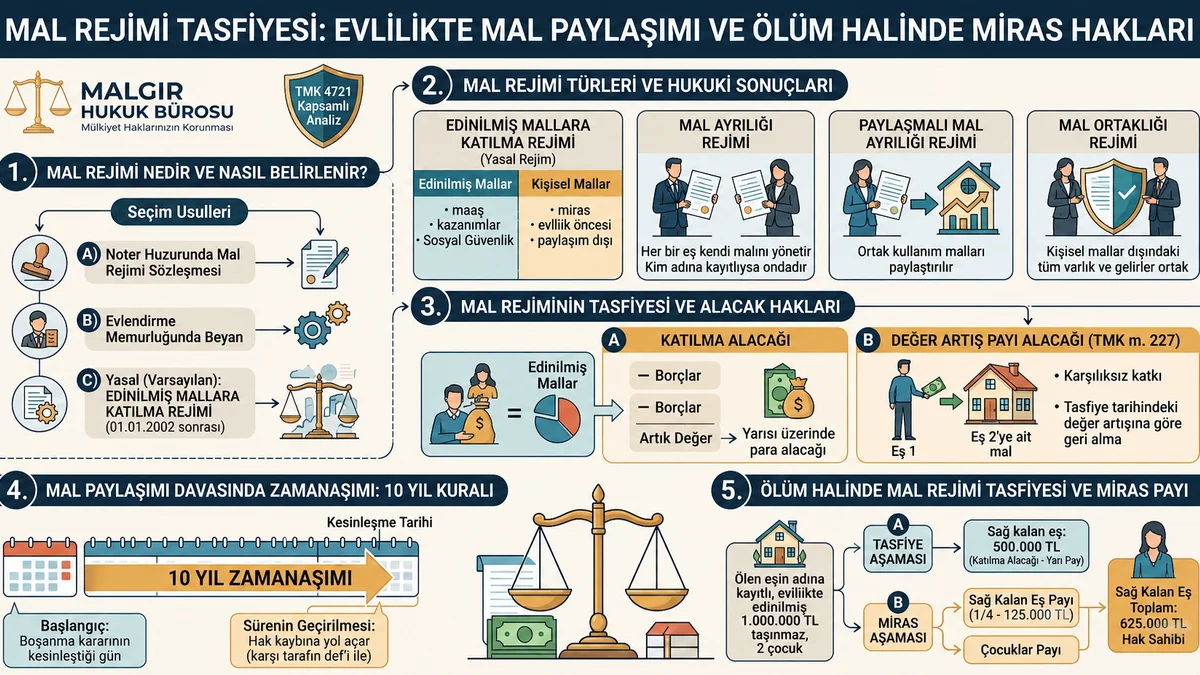
Liquidation of Matrimonial Property Regimes: Property Division in Marriage and Inheritance Rights upon Demise
The matrimonial union is a statutory partnership through which the asset values of spouses are bound to a specific legal status. Property division disputes emerging upon divorce or demise yield vastly distinct legal consequences depending on the specific matrimonial property regime to which the spouses were subject. To manage this process within the framework of equity, the Turkish Civil Code (TMK) No. 4721 has bound the boundaries of ownership and the procedures of liquidation to definitive rules.
As Malgır Law Firm, we analyze in deep detail the legal rights arising from the categories of property regimes, the mechanism of liquidation, and the statutory statutes of limitations executed throughout this process.
1. What is a Matrimonial Property Regime and What are its Formal Requirements?
A matrimonial property regime is a comprehensive set of rules that dictates the management, utilization, and eventual division upon the dissolution of the union of all assets owned by the spouses prior to marriage or acquired during the course of the marriage.
Spouses may select one of the matrimonial property regimes prescribed by law prior to the marriage, at the exact time of the wedding ceremony, or while the marriage continues:
Before a Public Notary: Spouses may select a matrimonial property regime distinct from the statutory default regime by executing a formal “Matrimonial Property Agreement” (Mal Rejimi Sözleşmesi) in the form of an ex-officio drafting or validation before a public notary.
At the Marriage Registry Office: During the formal application for marriage, the parties may declare in writing which specific property regime they have elected.
The Statutory Default Regime: If no specific alternative regime has been mutually chosen by the parties through a legally compliant contract, the “Regime of Participation in Acquired Property” (Edinilmiş Mallara Katılma Rejimi), which has been in force since January 1, 2002, applies by operation of law.
2. Categories of Matrimonial Property Regimes
Four primary matrimonial property regimes are regulated under the Turkish Civil Code:
Regime of Participation in Acquired Property (The Statutory Default Regime): Grounded upon the principle that assets acquired by spouses in return for financial consideration during the marriage (such as salaries, acquisitions in return for labor, etc.) are split fifty-fifty ($50\% / 50\%$) at the exact time of liquidation. Assets inherited from relatives or assets owned prior to the marriage are classified as “personal property” (kişisel mal) and are completely excluded from the division.
Regime of Separation of Property (Mal Ayrılığı Rejimi): A regime where each spouse retains their independent right of management, enjoyment, and disposal over their respective assets. Whosoever holds the registered title to an asset remains the sole rightful owner at the time of liquidation.
Regime of Shared Separation of Property (Paylaşmalı Mal Ayrılığı Rejimi): A regime where spouses are subject to the principles of separation of property, but with the specific caveat that investments dedicated to the common utilization of the family are divided equally upon liquidation.
Regime of Community of Property (Mal Ortaklığı Rejimi): A regime where all assets and income streams of the spouses—excluding their strictly personal belongings—are deemed common property.
3. The Liquidation of the Property Regime and Claim Rights
The liquidation of a matrimonial property regime is triggered upon the demise of a spouse, the finalization of a divorce decree, the annulment of the marriage, or switching to an alternative regime via a judicial court order. Throughout the liquidation process, a spouse can fundamentally assert two distinct categories of monetary claims:
Participation Receivable (Katılma Alacağı): The relative monetary claim right of a spouse over half of the “residual value” (artık değer) remaining after deducting all specific debts associated with the acquired property.
Contribution Claim / Value Increase Share (Değer Artış Payı Alacağı - Art. 227 TMK): The right of a spouse to claim a monetary return—proportionate to the rate of appreciation at the date of liquidation—for any uncompensated, extraordinary financial or material contribution they personally executed toward the acquisition, improvement, or preservation of an asset belonging to the other spouse.
4. Statutes of Limitations in the Liquidation of Property Regimes
Lawsuits for receivables arising from the liquidation of matrimonial property are subject to a separate procedural track and strict deadlines, completely independent from the divorce action itself.
The Limitation Period: Lawsuits stemming from the liquidation of the property regime (participation receivables and contribution claims) are subject to a 10-year statute of limitations commencing from the exact date the divorce decree becomes finalized.
Legal Characteristics: This period does not start running when the divorce lawsuit is initially filed; rather, it commences when the finalization stamp (kesinleşme şerhi) is officially placed upon the court decree. If this timeframe is exceeded, a statute of limitations objection (zamanaşımı def'i) raised by the opposing party permanently bars the enforceability of the claim.
5. Liquidation Upon Demise and the Computation of the Inheritance Share
In the event of the demise of a spouse, the rights of the surviving spouse are determined through a two-tiered statutory liquidation procedure. First, the liquidation of the matrimonial property regime is executed; subsequently, the provisions of inheritance law are applied over the remaining estate.
Operation of the Legal Procedure:
Assuming a scenario where the deceased spouse held a registered real property valued at 1,000,000 TL acquired during the marriage under the statutory default regime, and left behind a surviving spouse and 2 common children:
Tier 1: The Liquidation Phase: Pursuant to the statutory default regime, the surviving spouse first extracts half of the value of the acquired asset (500,000 TL) from the estate as their Liquidation (Participation) Receivable. This amount is subtracted prior to the calculation of the inheritance shares.
Tier 2: The Inheritance Phase: The remaining 500,000 TL is officially recognized as the inheritable estate (the successoral estate / tereke). Where the surviving spouse inherits alongside the first-parental line of descendants (the children), their statutory inheritance share is one-quarter ($25\%$), which amounts to 125,000 TL.
Subtotal Outcome: The surviving spouse legally acquires a total asset value of 625,000 TL ($500,000 \text{ TL} + 125,000 \text{ TL}$) through the combination of their matrimonial property claim and statutory inheritance share.
Conclusion
Matrimonial property law is a highly specialized domain requiring expert legal precision regarding the categorization of assets as personal or acquired, the evaluation of technical expert witness reports, and the strict tracking of statutory statutes of limitations. To prevent any forfeiture of rights, it is imperative to manage this process from start to finish under a flawless legal strategy.
Deploying our deep litigation experience, Malgır Law Firm provides professional legal consultancy and courtroom advocacy across all stages of family law—from the drafting of customized matrimonial property agreements to the litigation of liquidation actions and value increase calculations.
This article was prepared by Av. Mehmet Serhat MALGIR.