The Critical Threshold in the Divorce Process: Fault Proof, Alimony, Child Custody, and Your Surname Rights
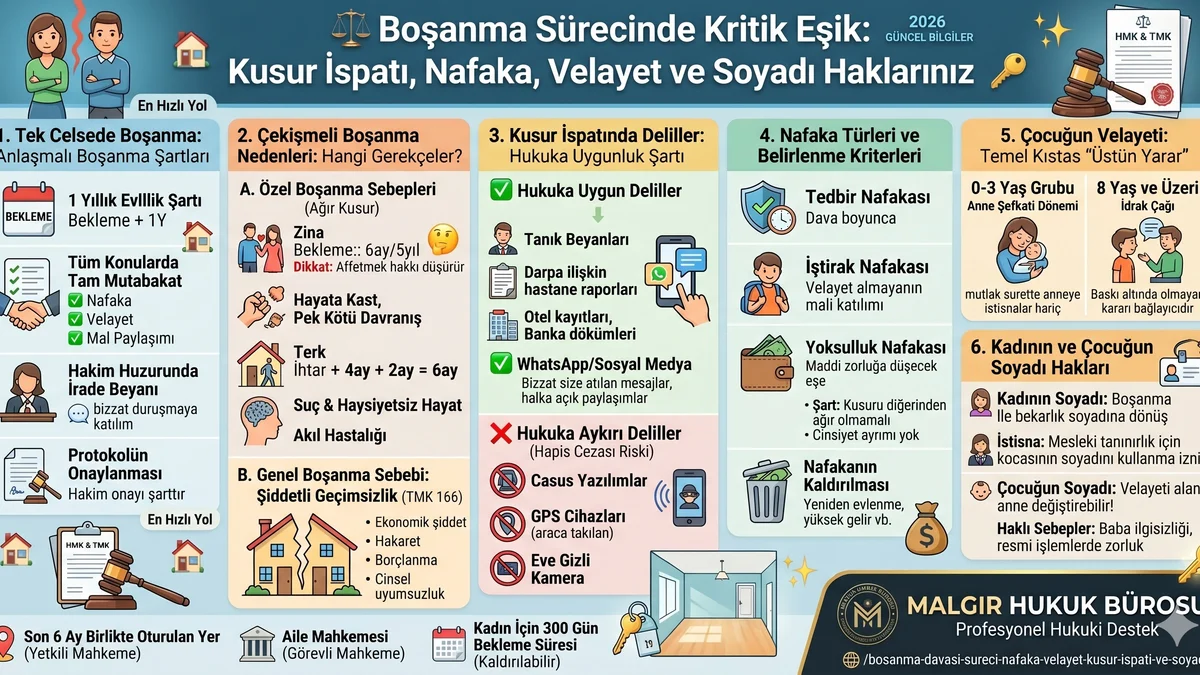
How to File for Divorce? Your Legal Rights in the Triangle of Fault, Alimony, and Custody
As emotionally challenging as a decision to divorce may be, it is equally bound by highly technical and strictly enforced legal rules in a court of law. The duration of the trial, the parent to whom child custody will be granted, or the exact amount of alimony to be adjudicated depend entirely on the statutory admissibility of the evidence presented to the court and the precise management of procedural time limits.
As Malgır Law Firm, we deconstruct the complex dynamics of the divorce process in full transparency, freeing it from colloquial misconceptions, under the guidance of the Turkish Civil Code (TMK) and contemporary jurisprudence of the Court of Cassation.
1. Divorce in a Single Hearing: What are the Requirements for a Consensual Divorce?
This constitutes the most expeditious path to dissolving a marriage, executed when the spouses reach a complete and flawless mutual understanding on all financial and legal consequences, including alimony, child custody, and the liquidation of matrimonial property. However, for a case to be finalized in a single hearing, the strict criteria mandated by law cannot be loosened:
The 1-Year Marriage Requirement: If at least 1 full year has not elapsed from the exact date of marriage, the spouses cannot legally initiate a “consensual divorce” (anlaşmalı boşanma) lawsuit, even if they agree on every single term. In such an instance, the case must statutorily be heard under the contested procedure.
Declaration of Intent Before the Judge: Even if you are represented by legal counsel, you are mandatorily required to personally attend the hearing and directly declare your intent to divorce and your acceptance of the prepared protocol to the judge in your own words.
Approval of the Protocol: The divorce protocol signed by the parties must pass the judicial scrutiny of the presiding judge. The judge has the legal authority to intervene in the protocol to safeguard the best interest of the child (for instance, if the judge deems the adjudicated child support amount insufficient).
2. Grounds for Contested Divorce: On Which Statutory Reasons Can a Lawsuit Be Filed?
If the spouses cannot reach a mutual agreement regarding the decision to divorce or its subsequent legal consequences (alimony, custody, indemnities), the lawsuit is litigated as a contested divorce (çekişmeli boşanma). The statutory grounds you can rely upon when filing a contested action are split into two categories:
A. Specific Grounds for Divorce (Acts Deemed Gross Fault)
When you legally prove one of these specific grounds, the judge is not required to investigate whether the marriage has “irreparably broken down”; the court directly rules for divorce and awards indemnities against the party found to possess gross fault.
Divorce Based on Adultery (Zina - Art. 161 TMK): Encompasses sexual intercourse committed with a person of the opposite sex. The lawsuit must be initiated within 6 months from the date the adultery is learned, and in any event, within 5 years from the occurrence of the act. Crucial Note: Condoning or “forgiving” the unfaithful spouse after learning of the incident permanently obliterates the right to file a lawsuit based on this specific statutory ground.
Intent on Life, Gravely Unkind or Humiliating Treatment (Art. 162 TMK): Subjecting a spouse to physical domestic violence (assault), threatening them with death, or leveling severe insults against them in public.
Divorce Based on Desertion (Terk - Art. 164 TMK): Against a spouse who abandons the common domicile without a justified reason, a formal “Notarial Notice to Return Home” is served on the 4th month of the desertion. If the spouse fails to return within another 2 months (once the total 6-month statutory duration is complete), the lawsuit can be filed.
Other Specific Grounds: Committing an honorable crime or leading an infamous lifestyle (Art. 163 TMK), and mental illness (Art. 165 TMK).
B. General Ground for Divorce (Severe Incompatibility)
Irreparable Breakdown of the Matrimonial Union (Art. 166 TMK): Encompasses any severe incompatibility that renders common life entirely intolerable, such as sexual dysfunction/incompatibility, economic violence, systematic insults directed at a spouse’s family, failing to provide financial support for the household, or triggering foreclosure proceedings on the family home due to excessive uncoordinated debt.
3. Evidence in a Divorce Lawsuit: Are WhatsApp Messages Legally Admissible?
In contested lawsuits, the proof of “fault” strictly dictates the final outcome of the case. Pursuant to the Civil Procedure Code (HMK), the evidence presented to the court must be obtained through legally compliant channels.
Admissible Evidence: Medical reports documenting physical assault, hotel logs, bank and credit card statements, and oral testimonies of witnesses who personally saw or heard the relevant events.
Unlawfully Obtained Evidence (Spyware / Casus Yazılımlar): Secretly installing a GPS tracking device on your spouse’s vehicle, covertly installing spyware applications on their mobile device, or hiding secret cameras in the common domicile are classified as unlawfully obtained evidence and are deemed inadmissible by the court. Furthermore, these actions can trigger criminal prosecution against you for the offense of “Violation of the Privacy of Personal Life,” carrying prison sentences.
WhatsApp and Social Media: Text messages containing threats, insults, or admissions sent directly to your own device, alongside your spouse’s public social media posts, are fully admissible as a compliant commencement of written evidence.
4. Categories of Alimony in Divorce and Adjudication Criteria
Alimony is not designed as a mechanism for the unjust enrichment of a party; rather, it is a statutory safeguard created to protect the children and the spouse who will fall into severe financial hardship due to the dissolution of the marriage.
Temporary Alimony (Tedbir Nafakası): A temporary maintenance sum awarded by the court while the lawsuit is actively pending, securing the basic living requirements of the spouse and children, such as housing and sustenance.
Child Support / Affiliation Alimony (İştirak Nafakası): The mandatory financial contribution that the non-custodial parent must provide toward the maintenance, healthcare, and educational expenses (such as private schooling or tutoring) of the child, proportionate to their own financial capacity.
Spousal Support / Permanent Alimony (Yoksulluk Nafakası): Maintenance awarded to a spouse who will fall into poverty due to the divorce, provided that their fault is not graver than the other spouse’s fault. The statute is strictly gender-neutral; a male spouse fulfilling the criteria can legally demand permanent alimony.
(Note: A Lawsuit for the Revocation of Alimony [Nafakanın Kaldırılması Davası] can be initiated if the alimony recipient remarries, leads an unmarried conjugal life with another individual, or secures a high-income employment position).
5. To Whom is Child Custody Granted? What is the Age of Discretion?
In custody disputes, there is only a solitary legal compass that the judge takes into consideration: the “Best Interest of the Child” (Çocuğun Üstün Yararı). The reciprocal faults of the spouses do not, on their own, dictate the custody arrangement unless their behavior directly conflicts with the welfare of the child.
The 0-3 Age Bracket (The Maternal Care Period): Unless the mother suffers from a severe substance addiction or a profound psychological disorder that directly endangers the life of the infant, the Court of Cassation awards the custody of children within this age bracket to the mother as an absolute rule.
Ages 8 and Above (The Age of Discretion / İdrak Çağı): Pursuant to settled high-court practices, children who have completed their 8th year are legally presumed to possess the age of discretion. The judge, under the guidance of a specialized expert pedagogue, directly asks the child: “With which parent would you prefer to live?” This decision, voiced by the child free from external duress, is highly binding upon the family court.
6. Revolution in Surname Law: The Surname of the Woman and the Child
Following recent landmark decisions rendered by the Constitutional Court rooted in the principle of gender equality, revolutionary rights have been granted regarding surname status:
The Woman’s Surname: Upon the finalization of the divorce decree, the woman automatically reverts to her maiden name. However, if she is a doctor, attorney, or artist recognized professionally by her married surname, and altering it would inflict commercial or professional damage, she can request judicial authorization from the court to continue utilizing her former husband's surname.
The Child’s Surname: Historically, the child’s surname remained strictly that of the father following a divorce. Under contemporary legal precedents, the mother who holds custody can now apply to the Family Court and successfully change the child’s surname to her own maiden name, provided there are justified grounds (such as the father entirely neglecting the child or the logistical difficulties created by surname discrepancies in official school or hospital records).
7. Court of Subject-Matter Jurisdiction and Venue
Initiating a lawsuit before the incorrect court results in a procedural dismissal, causing severe financial and temporal losses.
Subject-Matter Jurisdiction: The Family Courts (Aile Mahkemeleri) hold exclusive subject-matter jurisdiction over all divorce, alimony, and custody actions.
Venue / Territorial Jurisdiction (Art. 168 TMK): The lawsuit can be initiated either before the court of the domicile of the plaintiff, the domicile of the defendant, or the court of the locality where the spouses have jointly resided for the last 6 months preceding the filing of the case.
The Statutory Waiting Period for Women (İddet Müddeti): Pursuant to the TMK, a divorced woman cannot legally remarry until 300 days have elapsed from the finalization of the divorce decree. However, this restriction can be judicially lifted within a week by executing a brief lawsuit backed by a medical report verifying that the woman is not pregnant.
Conclusion
At this critical turning point in your life, Malgır Law Firm safeguards your statutory rights through a flawless litigation strategy. We represent you with the utmost respect for your privacy, ensuring you navigate this process with the least possible distress.
This article was prepared by Av. Mehmet Serhat MALGIR.